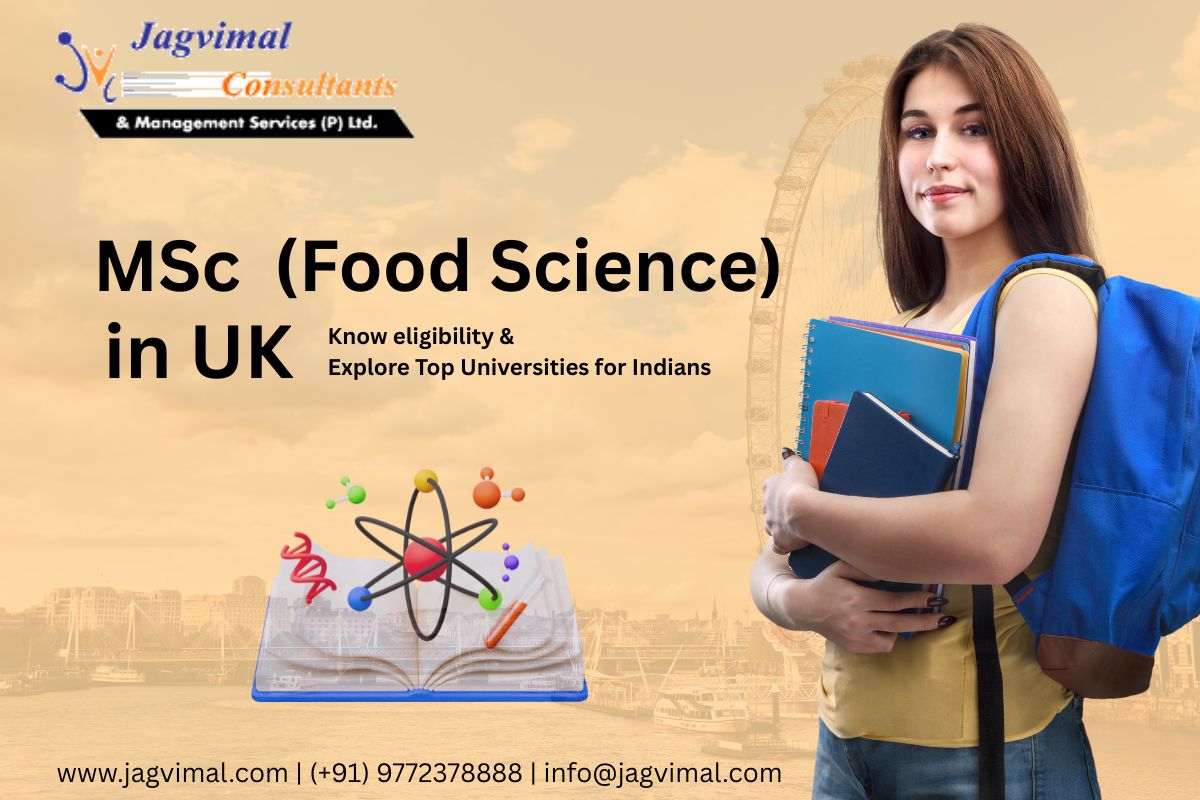
MSc in Food Science in the UK for Indian Students in 2026: Top Universities and Course
 Team Jagvimal

The MSc in Food Science is for students who want to understand the future of our food by getting a deep understanding of the science behind production, safety, and nutrition. A very specialized choice for postgraduate studies, the MSc in Food Sciences will teach about food chemistry, food microbiology, food biotechnology, quality assurance, and regulatory compliance. The United Kingdom has emerged as one of the most popular destinations for Indian students to pursue this degree in it's world class universities, state of the art research facilities, and programs that offer a perfect balance between theoretical knowledge with practical training for industry exposure. The program usually takes just one year to complete, thus offering an expeditious pathway to advanced qualifications and an entrance into the briskly rising global food sector.
Food Science is an important key and ever changing domain traversing the world and India as requirements of food safety, environmental sustainability, and new products change with consumer wants. Food scientists are well rewarded in food production, product designing, quality administration, and regulatory affairs. With special scholarships and post-study work available for Indian students in the UK, it definitely eases financial constraints on them and opens great career prospects ahead of them. This guide presents an extensive view of the MSc Food Science in the UK for Indian students for the year 2025-26, covering everything on universities, admission requirements, scholarships, course details, and career options.
Why Study MSc Food Science in the UK?
1. 1-Year Program with High ROI
Most of the UK Master of Science degrees in Food Science have a duration of one year. They are designed to equip students with skills immediately and at a reduced cost as well.
10,000 euros to 25,000 euros is the range of international student tuition fees.
2. Good Industry Demand and Professional Opportunities
The food and beverage industry in the UK is the largest manufacturing industry with an approximate of PS 104.4 billion and more than 450,000 employees.
The graduates can work as Food Technologist (PS31,599), Process Technician (PS30,997), Quality Manager (PS47,078), and Food Safety Auditor (PS26,000).
3. Experiential Knowledge and Industry Incorporation
Programs comprise food chemistry modules, microbiology modules, processing modules as well as innovation.
Lab work, research programs and industry placements provide students with practical experience.
4. High Employability
The UK graduates have good employability performance with universities such as the Anglia Ruskin taking the 1st position in their region in terms of graduates who work as managers, directors or senior officials within 15 months.
The UK has a healthy industry demand with an average graduate unemployment of about 12%.
5. Monetary Aids and scholarships
Scholarships available to Indian students include the Chevening, Commonwealth, and university specific ones like the Reading International Scholarship, Surrey International Excellence Award, and Warwick Chancellor International Scholarship to help reduce the costs.
Top Universities Offering MSc In Food Science in the UK
This is a table of the top UK universities that are offering MSc in Food Science, and highlighting the strengths of each program to an Indian student:
| University Name | Course Name | QS World Ranking 2026 | Annual Tuition Fee (EUR) | Approx. Fee in INR |
|---|---|---|---|---|
| University of Glasgow | MSc Food Security | 79 | €31,800 | ₹37.5 Lakhs |
| University of Leeds | MSc Food Science | 86 | €34,000 | ₹40.1 Lakhs |
| University of Nottingham | MSc Brewing Science & Practice | 97 | €30,200 | ₹35.6 Lakhs |
| Queen’s University Belfast | MSc Advanced Food Safety | 199 | €25,800 | ₹30.4 Lakhs |
| University of Reading | MSc Food Science | 194 | €30,950 | ₹36.5 Lakhs |
| University of Surrey | MSc Food Science | 262 | €24,900 | ₹29.4 Lakhs |
| Northumbria University | MSc in Nutritional Science | 550 | €20,950 | ₹24.7 Lakhs |
| Cardiff Metropolitan University | MSc Food Science and Technology | N/A | €16,000 | ₹18.9 Lakhs |
Eligibility Criteria for Indian Students
Indian Students eligibility criteria for MSc in Food Science in the UK are as follows:
Academic Qualifications: A bachelors degree with at least 2:2 or 2:1 honours (which translates to 55-65% or more in India) in the following disciplines: Food Science, Biotechnology, Chemistry, Biology, Biochemistry, Nutrition or Agricultural Science. Work experience in related fields may be perceived as relevant in some universities instead of formal qualification in related fields.
English Language Proficiency: You are required to show your understanding of the English language by proving how good you are at English language, you can also take test like IELTS, PTE, or TOEFL, depending on the university.
Additional Admission Requirements:
- The SOP is basically a story on what your passion for studying the field of food science is, your career objectives and why you have chosen the UK program.
- Normally it is 2 LOR both from academic and professional sectors, where it should be clearly mentioned that the candidate is compatible and with the requisite skill set.
- Curriculum Vitae (CV) of academic history, working experience, and internships as well as practical skills in the field of food science.
- There are also universities that might need to demonstrate related professional experience or research projects in the field of food science or other related fields.
These are the eligibility requirements and the preparation of full application documents that are very essential when Indian students want to study MSc Food Science in the UK.
Course Structure & Specializations
UK MSc Food Science Programs: Course Structure and Specializations:
- Normal Period: MSc Food Science in the UK is normally full-time and takes a duration of 1 year. Certain universities have part-time 2-year options.
Important Modules and Subjects:
- Among the significant topics, food chemistry, food microbiology, and safety, food processing technologies, food product development, nutrition, and food quality management can be outlined.
- Moreover, from industry to practical training, the diverse modules training credits are linked to, respectively, food safety management, food product development, biotechnology, sustainability in food manufacturing, sensory and flavour science, and regulatory practices.
Practical Exposure:
- The programs focus on practical learning and intensive laboratory work on food analysis, microbiological analysis and product development.
- Students do research work, which may result in a major dissertation or original research on a topical food science issue.
- Internships, industrial placements or advanced practice projects in conjunction with food companies are a common opportunity to augment real-world skills and employment opportunities.
- Such a mixture of high-level studies and practical studies prepares students to work in various positions in the food industry and research.
UK MSc Food Science living expenses (2025-26) of Indian Students
The monthly cost of living varies according to the city with an average range of:
- In London: If you are living in London as a student, your average expense will be EURO 1,450 to EURO 1,600 approx. 1.71 to 1.89 lakhs.
- In Other Cities of UK: In other cities it will be around EURO 1,100 to EURO 1,300 approximately 1.30 to 1.53 lakhs.
The expenses of Items for living are:
- Accommodation: If you are living in university hotels or sharing a flat then your expenses will be EURO 500 to EURO 1,200 per month.
- Food and Groceries: Your edible products expense will be between EURO 150 to EURO 300 every month.
- Transportation: Your travel expense will be EURO 40- EURO 100 per month.
- Other expenses like personal, entertainment, mobile, or internet will be EURO 70 to EURO 150 a month.
- Textbooks, course materials, laboratory and project materials will cost you EURO 200 to EURO 500 per year.
- Health Insurance and Visa Costs: It will cost you approximately EURO 1,266 to EURO 1,376, along with NHS surcharge and visa application.
Typically, the total costs of living are ranged from EURO 13,000 to EURO 18,000, 15.3 to 21.2 lakhs, annually, depending on one's lifestyle and the place of residence.
Living in London is very expensive compared to the costs in other cities. Students from India can cut down on their spending by moving to Manchester, Leeds, or Sheffield among others. It is better to budget a little higher expenses in the first couple of months on deposits, set up and orientation. These living expenses are without tuition fees and must be taken into consideration carefully when planning to study in UK.
Scholarships and Financial Support for Indian Students
Below are some popular Financial support and Scholarships in the UK (2025-26) for Indian Students Pursuing MSc Food Science:
Major Scholarships:
Chevening Scholarships are sponsored by the UK government and cover the full funding of studies, in particular, tuition fees, monthly allowance EURO1,378, travel expenses, visa fees and others. The scholarship is available for Indian students with strong academic background who can be future leaders. The deadline for the application is October 7, 2025.
Commonwealth Scholarships: This scholarship is inclusive of Full tuition, airfare, monthly stipend and study-related travel allowances for Indian students from select sovereign states. The application deadline is August 22, 2025.
GREAT Scholarships: The scheme, among other things, does also channel in grants and loans which add up to EURO 10,000 as the tuition fees and that covers a variety of postgraduate studies including the MSc Food Science. Deadlines are set according to the universities.
University Specific Scholarships:
- India Postgraduate Chancellor, University of Birmingham: This scholarship provides a EURO10,000 tuition fee discount. Deadline for application is May 31, 2025.
- Scholarships University of Reading: The university details are available in the process of application. Undergraduate students of MSc Food Science can receive up to EURO5,000 for tuition fees.
Queen University Belfast, University of Leeds, and Sheffield Hallam, the other cases of merit-based or partial scholarships for international students, might be worth pursuing.
Tips for Applicants:
- Starting soon your scholarship applications is recommended most of them have the deadline range from May to October 2026.
- Write a powerful Statement of Purpose including academic excellence and leadership, and professional objectives.
- Get two good Letters of Recommendation of academic or professional referees.
- Carry along all academic transcripts, scores of English proficiency test and passport.
- Make sure that you read and understand specific university scholarship requirements and documents.
By applying to several scholarships, one would greatly ease the financial load and increase the likelihood of financial aid success among Indian students who are seeking the MSc Food Science in UK.
Career Prospects and Salary Expectations
Indian students in the UK have prospects of career and salary after MSc in Food Science:
Popular Job Roles:
- Food Technologist: Innovate and refine food, guarantee compliance and safety.
- Quality Manager / Food Safety Manager: Control food quality assurance, enforce safety rules.
As a product development scientist you will be responsible for the development of new processes and new products.
Other relevant career opportunities in this field are various positions of food safety specialist, nutritionist, regulatory affairs officer, R&D manager, sensory scientist, and food policy analyst.
Salaries (per year on average) As Trends in The Given Job Titles:
- A food technologist is paid an average of EURO 32,000 which equals to INR 38.4 L.
- A quality assurance manager, is paid an average of EURO 40,000 which equals to INR 48 L.
- A product development scientist is paid an average of EURO 35,000 which equals to INR 42 L.
- A food safety specialist is paid an average of EURO 38,000 which equals to INR 45.6 L.
- A R&D Manager is paid around EURO 42,000 which equals to INR 50.4 L
The average salary of entry level positions in India is a range of INR 4-8 lakhs to similar positions, with an experienced, professional earning a lot more.
The UK Work Visa and Post Study Work:
- The Graduate Route visa enables foreign students to remain and work in the UK within 2 years of the degree completion.
- The visa offers good working experience in food sector in the UK and enhances career development.
- The UK also has employers who sponsor skilled workers to obtain longer term work visa to work in food science related positions due to the increasing demand in food manufacturing and the food research industry.
- MSc in Food Science in the UK has offered Indian students a high rate of career advancement, high wages and a good visa to start international careers in MSc in food technology colleges with safety, research, development and products development.
Conclusion
Studying MSc in Food Science in the UK provides the Indian students with a good combination of international exposure, high academic standards, and work skills in one of the most vibrant food industries in the world. Having world renowned universities, state of the art research centers and industry contacts, students are well exposed, and have a broad pool of career opportunities in food technology, quality management, product development, and research. UK is a low cost and a rewarding route to a successful career in food science due to its one-year program and a wide range of scholarships and post study work opportunities.
It is advised that the Indian students should ensure that they apply early in order to benefit out of the existing scholarships like Chevening, Commonwealth, GREAT, and university specific awards that can substantially relieve financial pressures. Indian students will have the assurance of using expert services to provide personal assistance and advice during the application, admission, and visa application process through agencies such as Jagvimal Consultants. Call Jagvimal Consultants to start the process of getting admission in the best UK universities to pursue MSc Food Science and achieve your dream.
Categories:
 University of Worcester
 IELTS Preparation
 Jagvimal Updates
 MBBS abroad
 Study in Australia
Related Blog Article :




















.jpg-13815.jpg)



.jpg-84451.jpg)























































































.jpg-36008.jpg)
.jpg-92124.jpg)
.jpg-97135.jpg)
.jpg-13644.jpg)
.jpg-88332.jpg)
.jpg-8170.jpg)
.jpg-41655.jpg)
.jpg-40139.jpg)
.jpg-36400.jpg)

.jpg-19130.jpg)
.jpg-55160.jpg)

.jpg-95270.jpg)

.jpg-68926.jpg)

.jpg-11639.jpg)
.jpg-90395.jpg)

.jpg-40845.jpg)














































































.jpg-71688.jpg)









































.png-88670.png)

.png-27959.png)



.jpg-45480.jpg)































































































.jpg-34623.jpg)
.jpg-76961.jpg)
.jpg-38318.jpg)
.jpg-48487.jpg)
 Instagram
 LinkedIn
 Facebook
 Twitter
 WhatsaApp
 Youtube
Related Videos :
 2025-09-10
 Mbbs Abroad Transfer| Semey State Medical University