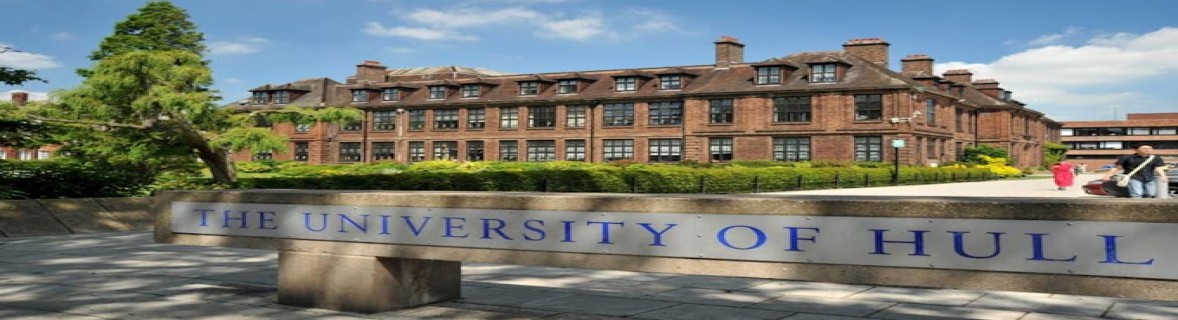

 Hull, England
 Est 1927
 University Type - Public
The University of Hull is a public research university based in Kingston upon Hull, a city in the East Riding of Yorkshire, England. It was founded in 1927 as University College Hull. The main university campus is located in Hull and is home to the Hull York Medical School, a joint initiative with the University of York.
There are also additional facilities in Scarborough, North Yorkshire, and the university has a research and teaching partnership with the University of Lincoln. The university's mission is to provide an outstanding education and research experience that enriches the lives of its students and staff contributes to the social and economic development of Hull and the wider region and plays a leading role in the development of a thriving, vibrant and diverse cultural life in the city and region.
The university has a strong commitment to research, with research-led teaching and learning at its core, and a focus on interdisciplinary and collaborative research. It has a wide range of research areas and expertise, including but not limited to: materials science, engineering, life sciences, health sciences, social sciences, humanities, and business and management. It also has a strong record of commercial success and has an impressive portfolio of spin-off companies and other forms of knowledge transfer.
The university is committed to creating a campus environment that is welcoming and inclusive for all, and it has a number of initiatives in place to ensure that its students feel supported and valued regardless of their background or beliefs.
The university also has an active student life, with a range of clubs, societies, and sports teams. It also has a range of facilities, including a library, sports center, and student accommodation.

The University of Hull charges tuition fees for all its courses, ranging from £9,250 to £9,250 per year for full-time undergraduate courses and International students pay the same fees. Postgraduate taught courses to range from £10,000 to £17,000 per year and postgraduate research courses range from £15,000 to £22,000 per year. Additionally, some courses have additional fees for resources, materials, field trips, and other activities.
The University also offers a range of discounts and scholarships, including a 10% discount for students with a household income of less than £25,000 and a 20% discount for students with a household income of £25,000 or less.
For more information, please visit the University's website.
The University of Hull is ranked in the top 3% of universities in the world according to the Times Higher Education World University Rankings. It is also among the top 150 universities in the world according to the QS World University Rankings. Additionally, the university is also ranked in the top 25 universities in the UK according to the Guardian University Guide.
The University of Hull has consistently been ranked highly for its teaching, particularly in the subjects of English, History, Geography, Law and Politics. It was awarded a Gold award in the Teaching Excellence Framework in 2017, which assesses the quality of teaching and learning at universities across the UK.
In terms of research, the University of Hull is ranked in the top 100 universities in the world according to the Times Higher Education World University Rankings. It is also ranked in the top 10 universities for research intensity in the UK according to the Research Excellence Framework (REF). In terms of student satisfaction, the University of Hull is also rated highly, with a score of 87% overall student satisfaction in the National Student Survey (NSS).

The University of Hull has different entry criteria for different courses. To be accepted on to an undergraduate course, students must hold either A-levels, BTECs, International Baccalaureate or equivalent qualifications.
Undergraduate entry requirements vary according to the course chosen, but typically students must achieve a minimum of two A-levels at grade C or above, or equivalent qualifications. For some courses, a minimum of three A-levels may be required.
In addition to academic qualifications, the University of Hull also considers other factors such as personal statements, references, interviews, and work experience.
For postgraduate courses, applicants must hold a first or upper-second-class honors degree or equivalent qualification. Additional entry requirements may also be set out by the department.
For international students, the University of Hull requires English language qualifications such as IELTS, TOEFL, or Pearson PTE Academic. The minimum score required for these qualifications varies depending on the course.
Finally, applicants must also meet any additional entry criteria that are specific to their chosen course. This could include work experience, an audition, or a portfolio of evidence.
You can find more information about entry criteria for specific courses on the University of Hull website.
To apply to the University of Kent, students should submit an online application and pay an application fee of £15. All international students must also provide evidence of English language proficiency, such as IELTS, TOEFL, or PTE scores. Additional requirements and documents may be requested depending on the program.
Where to Apply: Applicants should apply online through the University of Hull's website. Application
Fees: The University of Hull does not charge an application fee.
Admission Requirements: Applicants must meet the University of Hull's general entry requirements, which include:

The University of Hull offers a range of scholarships to support and encourage excellence in the academic study of its students. These scholarships are available to new and returning students and may cover tuition fees, accommodation, and other costs associated with the study.
To find out more about the scholarships available at the University of Hull, please visit the website or contact the university’s Student Services Department.











© 2026 Jagvimal Consultants & Management Services (P) Ltd.
 Birmingham City University
 University of Bedfordshire
 University of Chichester
 University of Chester
 University of Buckingham
 University of Central Lancashire
 University of Bolton
 Instagram
 LinkedIn
 Facebook
 Twitter
 WhatsaApp
 Youtube